
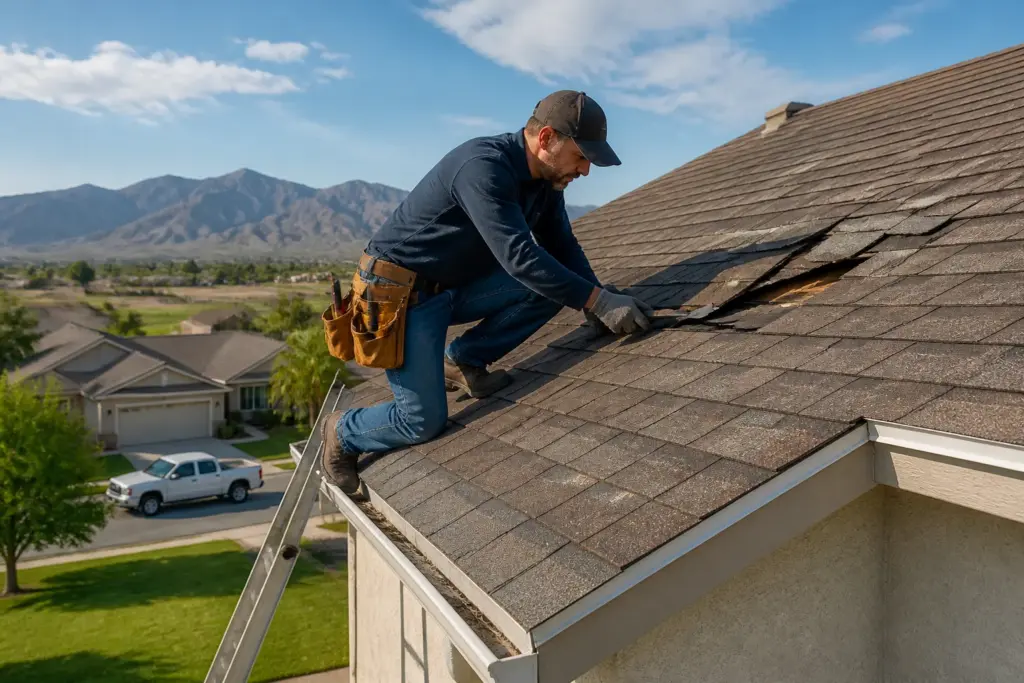
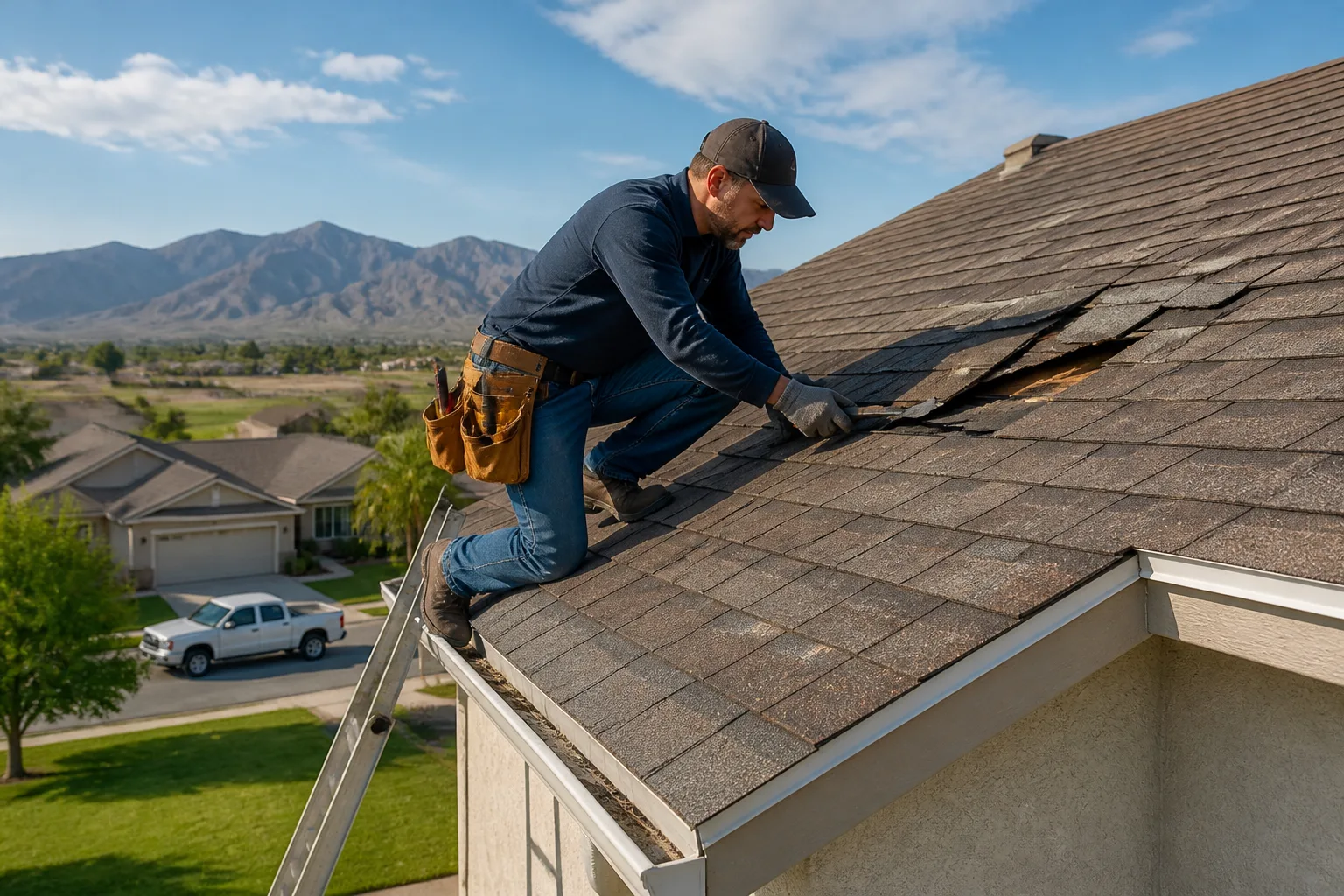
Roof Repair Cost Guide: What Ontario Homeowners Pay in 2026
Most roof repairs in Ontario, CA will run somewhere between $450 and $1,600 in 2026, with the majority of smaller jobs like shingle replacement or flashing fixes falling in the $500 to $900 range. That’s the honest answer. What makes the number move is the material, the slope of the roof, and how much of the underlayment has to come up. If you’d rather skip the research and just get someone on the roof, call (877) 731-1384 for a free estimate.
Here’s the thing most cost guides won’t tell you: the spread between quotes for the exact same repair in Ontario is not 10 or 15 percent. It’s routinely 40 to 60 percent. We’ve handed quotes to homeowners who showed us their other bids. Same scope. Same shingle count. Wildly different numbers. And the gap almost never comes from greed. It comes from how the contractor sources material, who’s actually on the roof with a nail gun, and whether the quote includes the steps nobody sees from the ground.
We pulled a rotted section of decking out of a house over near Cucamonga-Guasti Regional Park last fall. The homeowner had paid $400 to a day-labor crew to “seal” the leak two years prior. The seal didn’t address the failed underlayment underneath, and the water had been quietly eating the plywood the whole time. By the time we opened it up, the repair was $2,900 instead of the $600 it would have been on year one. That’s not a cautionary tale about cheap contractors being crooks. It’s what happens when a quote covers the visible surface and skips the layers below. So let’s get into what actually drives roofing repair costs in Ontario in 2026, so you can read a quote and know what you’re looking at.
Key Takeaways for Ontario Homeowners
- Expect to pay $450 to $1,600 for most roof repairs in Ontario, CA in 2026.
- Material prices for asphalt shingles are up roughly 8 to 12 percent since 2024, and clay tile repair mortar runs higher on the west side of the Inland Empire than the national average.
- The single biggest cost variable is underlayment: whether the quote includes replacing it in the repaired section, or just slapping shingles over the old felt.
- Employee crews cost more per hour than subcontractor crews, but that cost shows up as better warranty backing and a single accountable company.
- Insurance claims underpay on disposal and underlayment line items in Ontario. Roughly a third of the repair scopes we inspect after an adjuster visit are missing those.
- Material brand access is a cost lever. Contractors locked into one manufacturer pay whatever that distributor sets. Contractors who work with multiple brands, including Atlas, IKO, and Tamko, can shift material to fit a budget without changing the quality of the repair.
If you’re already staring at a wet ceiling in Ontario, you can jump ahead to the insurance section or the quote-review section. Or call (877) 731-1384 and we’ll walk through it with you.
For a deeper dive into repair scopes and what’s fixable versus replaceable, see Roof Repair in Ontario.
2026 Material Cost Benchmarks for Ontario, CA
National averages don’t tell you much when you’re in Ontario. We get heat in the summer that bakes asphalt shingles above 150 degrees on the surface, and we get Santa Ana wind events that turn a minor lifted shingle into a missing shingle overnight. That local reality moves material prices and repair volume. Here’s what material pricing actually looks like in Ontario CA in 2026, per square (100 square feet of roof area), not per bundle.
| Repair Material | Typical Ontario, CA Range (per square) | Notes |
|---|---|---|
| Asphalt shingle replacement (mid-grade, Atlas or IKO line) | $160 to $260 | Includes underlayment and fasteners |
| Clay tile repair mortar and respotting | $25 to $55 per tile | Labor-heavy due to access and matching |
| TPO patch (flat section or low-slope roof) | $8 to $14 per square foot | Includes fleece-backed patch and heat weld |
| Flashing metal replacement (aluminum or galvanized, custom-formed) | $12 to $18 per linear foot | Valleys and step flashing carry different labor |
| Underlayment replacement (synthetic or #30 felt under repaired section) | $1.15 to $1.85 per square foot | Most commonly omitted line item in sub-$500 quotes |
Clay tile is the wildcard in Ontario, because so much of the older housing stock north of the 60 and around Chaffey, Ontario was built with concrete and clay tile. Tile doesn’t fail the way shingles do. It cracks, shifts, or spalls, and often the repair means removing a dozen tiles to get at the felt underneath. That felt is what typically rotted out, not the tile itself. If you have tile and a leak, budget for underlayment work, not just mortar.
One thing we do differently at Hawk Roof Repair is maintain our material relationships across seven major shingle and roofing brands: GAF, CertainTeed, Owens Corning, IKO, Atlas, Tamko, and Boral. That’s not marketing fluff; it’s a supply chain advantage that shows up in pricing for Ontario repairs. A contractor locked into one manufacturer pays distributor-set pricing and passes that along. We can spec a repair with Tamko shingles on a rental property and IKO on a primary residence, matching the material to the budget and the home, not to whatever we happen to have on the shelf.
If your roof has reached the point where patch-on-patch no longer makes sense, see Roof Replacement in Ontario for a breakdown of when full replacement is the cheaper long-term play.
How Labor Structure Changes the Price You Pay
There are two ways a roofing company in Ontario staffs a repair: employee crews or subcontractor crews. Both can produce good work. The structure itself changes what you pay and what happens if something goes wrong.
Employee crews work for the company whose name is on the invoice. They’re paid hourly or salary, they carry workers’ compensation under the company’s policy, and their workmanship is backed by the company’s warranty. If a repair fails, you call the office, and the same company sends someone back. Employee crews cost more per hour because the company is carrying insurance, payroll taxes, and training. That cost lands in your quote, and it’s why some of the more established Ontario roofing companies are not the cheapest.
Subcontractor crews are independent. The general contractor writes up the scope, then hands it to a crew leader who brings their own guys. The workmanship warranty may be with the general contractor, but the actual repair quality depends on a crew that may be doing roofing for three different companies in a single week. Subcontractor pricing lands 15 to 25 percent lower on average for the same nominal scope. The risk is consistency. Some subcontractors are excellent. Some are averaging two roofs a day and not waiting for the felt to lay flat.
In Ontario, we’ve repaired no shortage of subcontractor-installed roofs where the shingles were nailed too high and the sealant strip never locked. The roof looked fine for a year, then a wind event peeled a whole slope. The homeowner called the original company and got a voicemail. That’s the hidden cost of the lower bid: not the repair itself, but the liability structure behind it. When a homeowner asks us why our quote is higher, the answer is generally not the material. It’s the fact that our crews are ours, they’re covered, and if the repair doesn’t hold, we’re the ones on the hook and back on the roof.
The Line Items Every Ontario Repair Quote Should Include
A written roof repair quote should read like a recipe. Not “repair leak at chimney” with a single line total. You want the components, because the components are what protect you from a $450 quote that turns into a $2,900 surprise the day the decking comes off. Here are the line items we put in every written proposal at Hawk Roof Repair, and what to ask for from any contractor bidding in Ontario.
- Decking inspection and replacement allowance. The plywood or OSB under your shingles is the decking. You can’t see its condition from ground level, and a contractor can’t quote rot they haven’t exposed. A good quote lists a per-sheet replacement allowance out in the open, not in fine print or not at all.
- Underlayment specification. This is the layer between the decking and the shingles or tile. The quote should name the product: synthetic underlayment, #30 felt, self-adhered ice-and-water shield. “Roofing felt” with no brand or grade is a red flag.
- Disposal fees. Torn-off shingles, old felt, and broken tile don’t throw themselves into a dumpster. In Ontario, disposal fees run $80 to $220 per repair on average depending on volume. A quote without a disposal line means someone is either not accounting for it or planning to bury it in the material markup.
- Permit disclosure. Most small roof repairs in Ontario do not require a permit. But any repair that changes more than a certain square footage or involves structural work on the decking can trigger one. The contractor should state plainly whether they’re pulling a permit and who’s responsible for the fee. If the quote is silent on permits, ask.
- Fastener and sealant type. It sounds small, but the difference between a roofing nail and a ring-shank nail, or between a polyurethane sealant and a cheap caulk, is the difference between a repair that lasts three years and one that lasts twenty. If a contractor can’t tell you what they’re using, they’re probably using whatever was on sale.
We inspect first. Every time. No ladder-top sales pitch. That’s not a tagline; it’s the point of our Roof Inspection in Ontario service. A standalone inspection documents what’s actually wrong, in photos and writing, before any price conversation happens. Whether you use Hawk or another company, demanding that separation is the single best protection against low-bid scope games.
Insurance Claims vs. Out-of-Pocket: What Adjusters Miss in Ontario
Roof repairs in Ontario that follow wind or storm damage often go through homeowners insurance. That’s good, because many of the repairs we do in October and January originate from Santa Ana wind events, not normal wear. But insurance claims have a structural bias you should know going in: adjusters write scopes for what’s visible from the ground or in photos, and the things they underpay or omit are the things that actually determine whether the repair holds.
The two line items adjusters most often short or skip entirely are underlayment and disposal. Underlayment is the easiest thing for a scope to ignore, because the adjuster never sees it. But in Ontario, when shingles blow off, the underlying felt is frequently torn or degraded too. Re-shingling over torn felt is a temporary cover, not a repair. We document this in our inspection reports with photos before the adjuster visits, which changes the conversation from a fight to a straightforward scope correction.
Disposal is smaller but still real. The adjuster’s software may assume disposal is “included” in the line-item pricing, which is true in some states and simply not how Ontario waste haulers price tear-off debris at the transfer station.
Here’s how to document roof damage in Ontario before you call the insurance company:
- Take photos the day you see the damage. Every slope, every downed shingle, every lifted seam. Wind damage is harder to authenticate a week later after rain has beaten the evidence flat.
- Don’t climb on the roof to take photos. Use a drone if you have one, or ask for a roof inspection from a company that provides photo documentation. A steep roof and loose tile is not where you want to learn about gravity.
- Note the date and weather conditions. Ontario gets specific wind events, and adjusters correlate claims against local storm data.
- Get a written repair scope with line items before the adjuster writes theirs. One contractor’s itemized estimate gives you a comparison point when the insurance scope comes back thin.
We also handle insurance work in Ontario, but our repair pricing doesn’t change just because insurance is paying. Same written scope, same material choices, same labor. The only difference is the paperwork.
Why Material Brand Access Moves Your Repair Price
Most Ontario roofing companies carry a primary line. If you call a company that’s a certified installer for one big shingle brand, they’ll spec that brand on every repair, because that’s their supply agreement and their volume discount depends on it. That’s not a scam. It’s a business model. But it means your repair quote is partly determined by whatever that distributor charges, which is not always the most logical fit for a 1,200-square-foot ranch in Ontario or a tile-to-shingle transition on a 1970s split-level.
Hawk Roof Repair carries relationships across seven brands: GAF, CertainTeed, Owens Corning, IKO, Atlas, Tamko, and Boral. In practice, for a repair, that means we can match the existing shingle’s profile and color from multiple manufacturers instead of telling you the closest option costs a premium because it’s special-ordered from one. Atlas and Tamko both produce lines that hit a mid-range price point with solid wind warranties, which matters for Ontario’s Santa Ana exposure. IKO’s dimensional lines often beat the premium brands on cost per square without sacrificing the look on a standard ranch. The point is that material is a variable in a repair, not a fixed input. Any contractor who presents one material option as “what we use” is simplifying the process for their benefit, not yours.
When to call a pro instead of patching it yourself: any repair that involves ladder work on a two-story home, any work on a roof steeper than a 6/12 pitch, any tile repair where the underlayment may be compromised, and any leak that’s already showing up on an interior ceiling. If water is inside the house, the roof failure is past cosmetic. A cavity of wet insulation and drywall is not a caulk job. Related services in Ontario: Hawk Roof Repair home covers the full roof repair service area, and we handle inspections and full replacements in-house, so you’re not coordinating three contractors as the roof’s condition dictates.
Around Ontario, we’ve seen repair quotes that skip underlayment entirely to hit a price point, and we’ve seen homeowners replace an entire roof when the actual problem was one chimney saddle flashing and a cracked valley. The inspection-first approach catches both. If you’re unsure whether your quote includes the right layers, call (877) 731-1384 and we’ll review it with you, no charge.
The Bottom Line
Ontario roof repair pricing in 2026 is not a mystery. It’s a function of material, labor structure, and whether the quote includes the layers that actually keep water out. The cheapest quote is not automatically a bad deal, but it is automatically the one that requires the most scrutiny, because corners in roofing are cut in the places you can’t see until it rains. The right repair on the wrong underlayment is still the wrong repair.
If you’re in Ontario and need a straight read on your roof, Hawk Roof Repair offers free estimates. We document what’s actually wrong before any price conversation, we spec repairs with whatever material fits your home and your budget, and our crews answer to us, not to a middleman. Call (877) 731-1384 to schedule a free estimate.
Written by the team at Hawk Roof Repair, serving Ontario since 2017.
Frequently Asked Questions
Most roof repairs in Ontario CA in 2026 run between $450 and $1,600, with small shingle or flashing fixes averaging $500 to $900 and larger underlayment or decking repairs reaching $2,500 to $4,000. The cost depends on material type, roof accessibility, and whether the quote includes underlayment replacement. Call (877) 731-1384 for an exact quote on your roof.
Quotes in Ontario vary 40 to 60 percent for identical scopes because of three factors: material sourcing (single-brand contractors pay distributor-set pricing while multi-brand contractors can shop the market), labor structure (employee crews cost more than subcontractors but carry stronger warranty backing), and line-item inclusion (many low bids omit underlayment, disposal, or decking allowances that appear later as surprise costs).
Homeowners insurance in Ontario typically covers roof repairs that result from sudden events like wind damage or falling debris, not from age or deferred maintenance. Adjusters often underpay on underlayment and disposal line items, so homeowners should get an itemized contractor scope before the adjuster writes theirs. Call (877) 731-1384 if you need help documenting damage.
Repair makes financial sense in Ontario when the damage is localized to one or two areas and the existing underlayment is still functional. Replacement is cheaper long-term when the roof is past 80 percent of its lifespan, the roof deck has rot in multiple sections, or you’re paying for frequent repairs on a failing underlayment. If you’re not sure, an inspection should come before either decision. See Roof Inspection in Ontario for details.
Need Roofing Help?
Call Hawk Roof Repair — licensed & insured, here with fast after-hours help in Ontario.
(877) 731-1384